Daily Edition · Page 1

THE DAILY INDEX

Technology, AI, software, security, crypto and business

Across today’s newsletters

Today’s Index
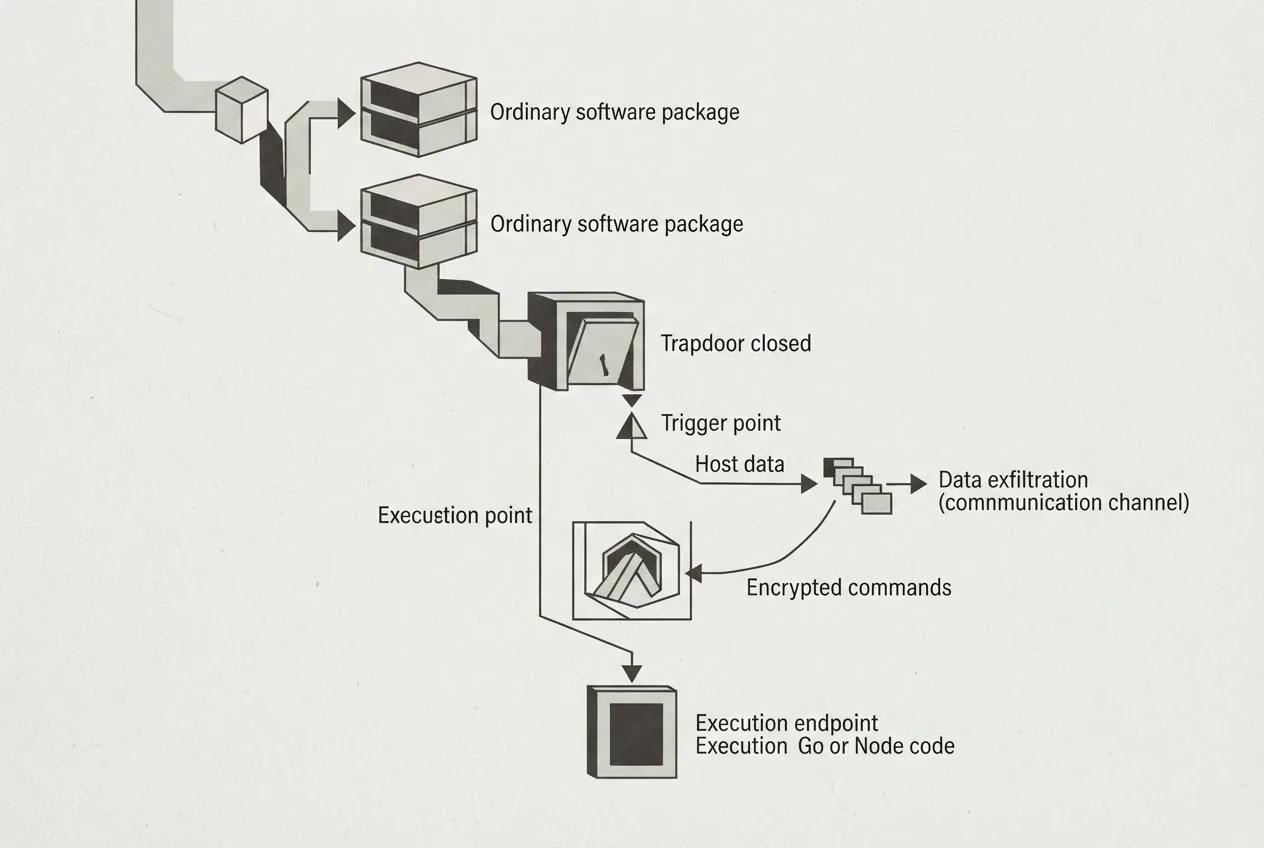
A software dependency path hides a conditional trapdoor: a trigger activates execution, host data travels outward, and encrypted commands return through separate channels.
AI-generated editorial illustration

GRAPHALGO CAMPAIGN SPREADS TO TERRAFORM PROVIDERS AND GO MODULES

Graphalgo malware appeared in two Terraform providers and two Go modules. Trigger conditions hide execution until targeted inputs appear, and the payload reports host data through Slack, receives encrypted commands through Slack and an Arbitrum Sepolia contract, then runs Go or Node code. Aikido recommends removing affected packages, isolating exposed hosts, rotating credentials, reviewing deployments, and reimaging machines.

CIRCLE OPENS BITCOIN-BACKED USDC BORROWING TO MINT CLIENTS, ROUTED THROUGH MORPHO

Circle has launched a Bitcoin-backed USDC borrowing facility for Mint clients through Morpho's Arc market, wrapping deposited BTC as cirBTC to serve as collateral. The cirBTC/USDC market grew ~10x in five days, from $1.37 million on September 17 to $14.3 million in borrowed USDC against 287 cirBTC tokens. Galaxy and Keyrock supply the dollar liquidity, while Circle handles cirBTC issuance and wallet infrastructure, and Morpho governs loan terms. The structure gives institutional Bitcoin holders access to USDC without liquidating their BTC positions.

IONQ'S REAL-TIME DECODER RUNS A SIMULATED 408-LOGICAL-QUBIT TRAPPED-ION COMPUTER ON A SINGLE LAPTOP CPU

Fault-tolerant quantum computers need a classical decoder to keep pace with error-correction cycles in real time, or a backlog builds that slows the whole computation exponentially. IonQ researchers showed a decoder running on just twelve cores of an Apple M4 Max MacBook Pro chip could keep pace with a simulated 408-logical-qubit trapped-ion machine, using two sliding-window decoders per code block, a slower, highly accurate one tracking corrections for the whole computation, and a faster one handling time-critical logical measurements.

TLDR IndexPage 1