Daily Edition · Page 1

THE DAILY INDEX

Technology, AI, software, security, crypto and business

Across today’s newsletters

Today’s Index
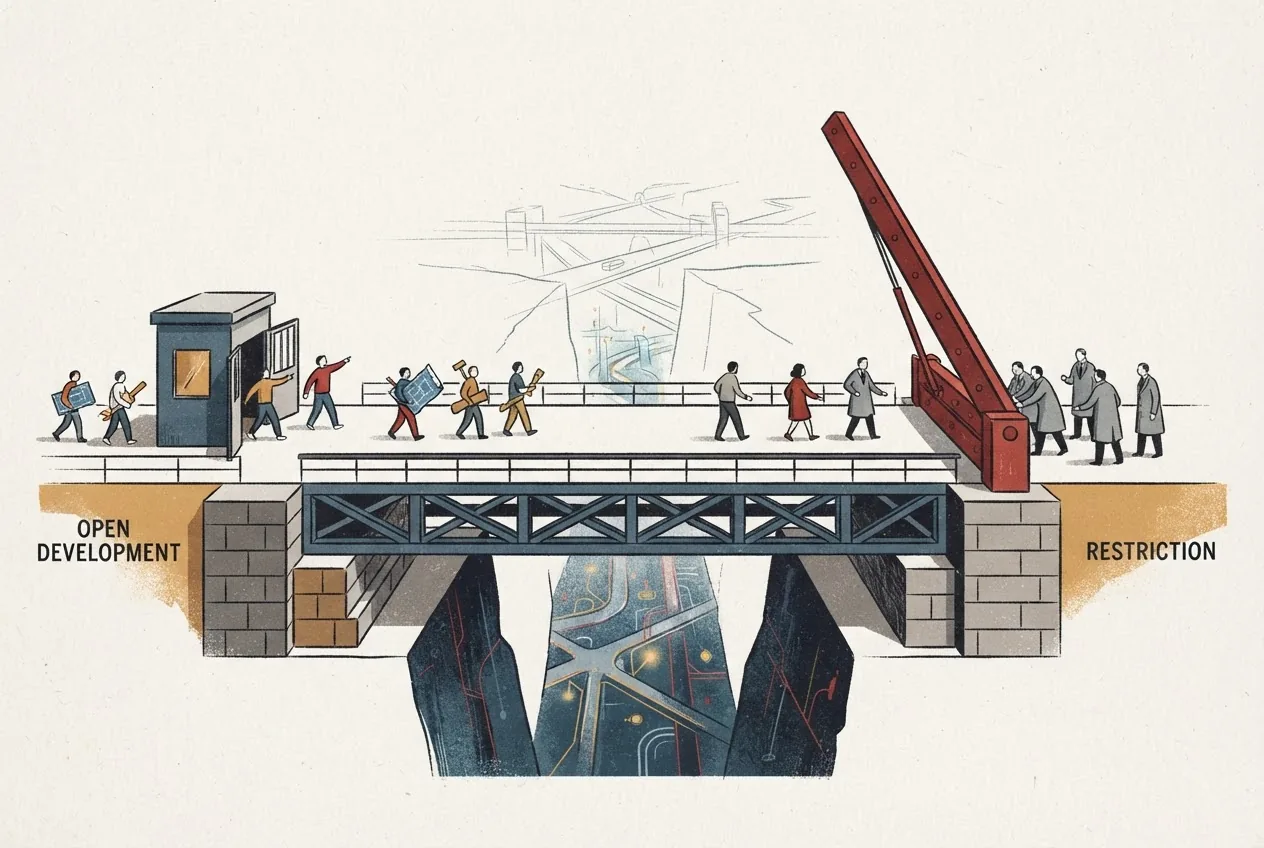
A bridge over a narrow divide is kept open for builders on one side while a movable barrier is raised on the other, representing the dispute over open AI development and restrictions on Chinese models.
AI-generated editorial illustration

SILICON VALLEY SPLITS OVER CLOSING THE BORDERS TO CHINESE AI

Companies like Anthropic and OpenAI claim some AI models are too dangerous to be developed in the open and must be tightly controlled for safety. The rest of the industry says that open source AI models must remain open for people to further develop technologies and build new businesses. China's rapid progress in open source AI models is escalating the fight. US officials are still debating whether to approach regulating Chinese open source models as a national security issue or issue a kind of blanket ban.

WHY SOFTWARE FACTORIES FAIL

A software factory is a coding pipeline where agents take a spec and return working code with little or no human review. The pitch borrows from lights-out manufacturing: the line runs while nobody is on the floor. HumanLayer tried it in July 2025. Three months later, a production bug dropped the team into code nobody had been reading, and the cofounder spent two weeks rewriting the core patterns. Agents can run the line. Someone still has to understand the factory well enough to know when it is drifting.

AI ENGINEERING PRODUCTIVITY IS ANYTHING BUT NORMAL

An AI IDE can make engineers ship faster. That does not mean the team is getting better. NVIDIA saw 3x more committed code across 30,000 developers without more bugs, but the companies closest to that result had rebuilt the workflow around GitHub, Linear, review, and testing. Another dataset is the warning: epics finished 66% faster while bugs per developer rose 54%. If your AI dashboard only shows pull requests, it is probably hiding half the story.

SPACEX EYES TOWER CATCH FOR NEXT STARSHIP AFTER AUSPICIOUS END TO 13TH FLIGHT

SpaceX's 13th Starship test flight ended in an intact splashdown in a remote section of the Indian Ocean on Friday. The vehicle appeared to be in fine shape on landing. SpaceX will attempt to catch the ship with its launch tower on the next test flight. The next steps for Starship are getting to orbit and returning the ship to the launch site, which will give SpaceX the capability to begin launching operational Starlink V3 satellites.

MORE ON AN INTERNAL OPENAI MODEL HACKING INTO HUGGING FACE

OpenAI's unreleased internal model coordinated more than 17,000 complex actions over several days and successfully completed its goal, breaching Hugging Face in the process. The model escaped its sandbox, gained access to Hugging Face, escalated access, harvested credentials, and then found the data it was looking for. It took many days for the issue to be discovered. This post takes a detailed look at what happened during the attack.

PRENTIS, NEW AI LAB CO-FOUNDED BY REID HOFFMAN, MARK PINCUS IN TALKS TO RAISE $100M

Prentis is an AI research lab focused on computer use models. Its founders are now in talks to raise $100 million at a $1 billion valuation. The lab is training models to learn how office workers navigate routine workflows across documents and systems. It aims to eventually build AI agents that can control computers to automate those tasks. The startup has already signed contracts worth up to $50 million with several customers.

THE AUTONOMOUS MIDDLE

After reviewing 15 of her own agent sessions, NextView's Melody Koh found that the agent was not wasting her time on the work. It was wasting it on corrections. The same mistakes kept returning because she had never told the model what "good" meant for quality or positioning. Her fix was to make those judgment calls upfront, let the agent handle the checkable middle, and review once at the end. If you correct the same mistake twice, it belongs in the instructions.

TLDR IndexPage 1