Daily Edition · Page 1

THE DAILY INDEX

Technology, AI, software, security, crypto and business

Across today’s newsletters

Today’s Index
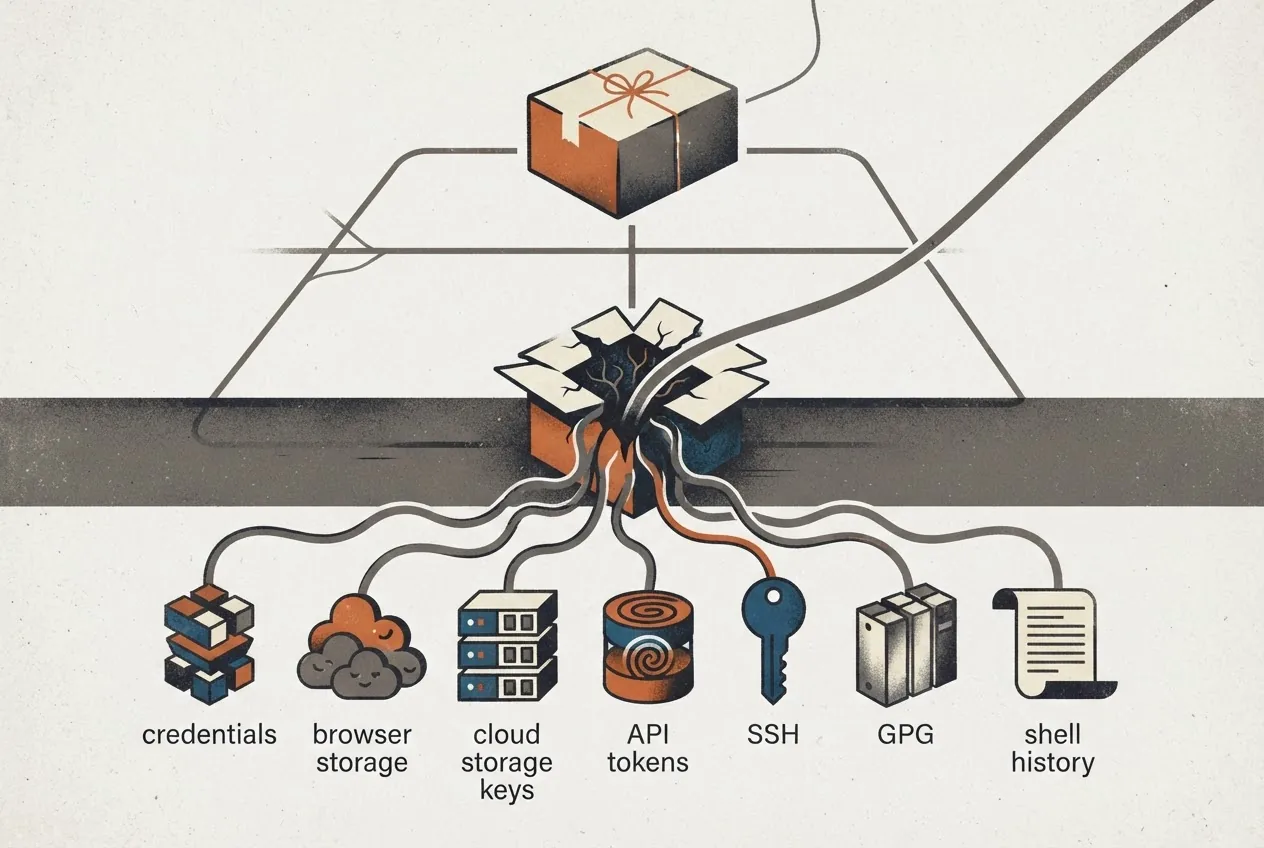
A software package moves from a trusted release path into an execution boundary, where its opened interior exposes pathways to browser, cloud, API, SSH, GPG, and shell-history secrets and sends them outward.
AI-generated editorial illustration

LITELLM SUPPLY CHAIN ATTACK HOOVERS UP PASSWORDS AND SECRETS

Attackers compromised LiteLLM's release process and published version 1.107.0 through PyPI and Docker. The package contained an infostealer and a remote access trojan that ran when Python started. It collected browser, AWS, Google Cloud, Azure, LLM API, SSH, GPG, and shell-history secrets, encrypted them, and sent them to an attacker domain. PyPI and Docker removed the package. Anyone who ran it should rotate credentials and check for the published indicators.

GITLAB CRITICAL PATCHES INCLUDE ONE FOR A BUG THAT ALLOWS CODE EXECUTION BY UNAUTHENTICATED USERS

GitLab released patches for 12 issues, including CVE-2026-110264, a critical integer-overflow flaw in its regular-expression compiler. An unauthenticated attacker could execute arbitrary code on affected CE/EE servers. Fixes cover versions 18.11.13 through 19.5.1. Affected releases date back to 7.0. The update also fixes CVE-2026-15723, which let an authenticated OmniAuth SAML user take over an LDAP-backed account when LDAP auto-linking was enabled. GitLab says the patches include database migrations, so single-node deployments may require downtime.

SOLANA'S BIGGEST NETWORK CHANGE SINCE 2020 IS LIVE

Solana activated Alpenglow on Wednesday. It targets finality of about 150 milliseconds under normal conditions, down from several seconds. Validators now send votes directly to each other and combine approvals into certificates, so a block can finalize after one or two voting rounds. Before, votes were recorded as transactions across successive blocks. The handover took about 900 ms, and 446 of 654 validators voted on the starting block. Apps often showed payments as confirmed before full settlement, so the change mainly gives stronger assurance. Exchanges could credit deposits sooner, and shops could confirm stablecoin payments faster. The 150 ms figure is a target, not a guarantee, and Anza said some computers receive finality information later than voting validators. Wallets, fees, and how apps run are unchanged. Validator votes no longer appear as transactions, so dashboards will show a sharp drop in transaction totals even though user activity hasn't changed.

SPACEX IN TALKS TO ACCESS 80,000 CELL SITES FOR NEW NETWORK

SpaceX is in talks with Crown Castle Inc., one of the largest owners of cellular towers in the US, as part of its plans to secure a minimum of 80,000 cell sites across the country. Crown Castle is likely also in talks with Amazon and other satellite-based telecom providers regarding leasing deals. Elon Musk has openly discussed creating a standalone wireless carrier from scratch. SpaceX recently acquired low-band spectrum and has received approval to launch 15,000 satellites to provide mobile service directly to phones.

NEW SUPERCONDUCTING CHIP AIMS TO HELP TAME FUSION PLASMA

Brookhaven National Laboratory debuted a superconducting chip built with other US Department of Energy facilities and AI hardware startup Great Sky to monitor fusion plasma in real time. The chip runs a neuromorphic neural network meant to spot signs that superhot plasma is about to become unstable. Its backers hope the hardware is fast enough to help control plasma before disruptions form, a prerequisite for practical fusion power.

TLDR IndexPage 1