Daily Edition · Page 1

THE DAILY INDEX

Technology, AI, software, security, crypto and business

Across today’s newsletters

Today’s Index
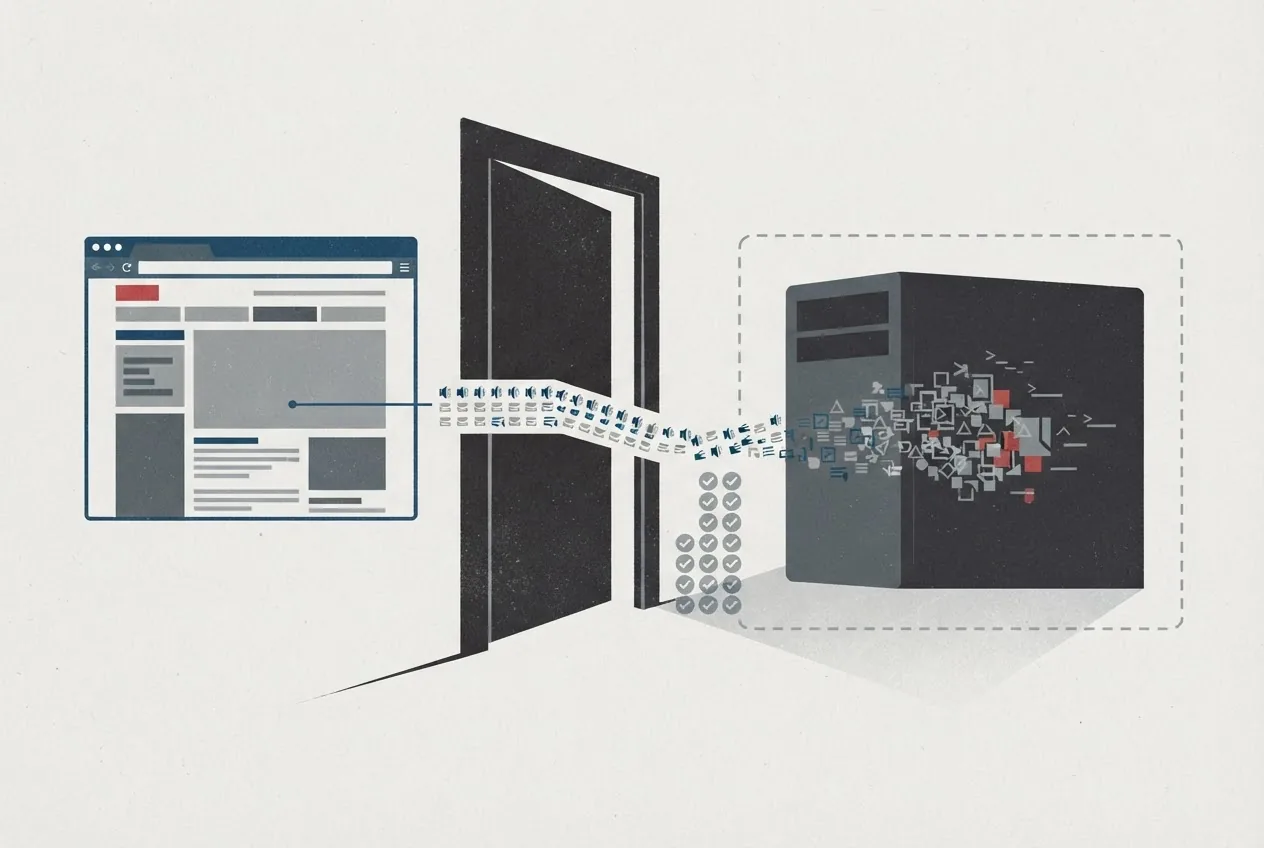
A browser window reaches through an open threshold toward a desktop computer as a prompt crosses the boundary and approval indicators accumulate, illustrating how Claude Dispatch could connect a web session to remote command execution on a work computer.
AI-generated editorial illustration

ANTHROPIC WON'T FIX A CLAUDE DISPATCH FLAW THAT COULD LET ATTACKERS EXECUTE REMOTE COMMANDS ACROSS CORPORATE BOUNDARIES

A browser extension with access to claude.ai can use Claude Dispatch to send prompts to Claude Desktop and achieve remote code execution. The attack exploits shared web and desktop sessions, repeated approval clicks, and a malicious npm package. It can also reach a work computer from a personal browser session. Anthropic knew of the issue in May but has not issued a fix. Dispatch remains available to existing users.

HACKERS EXPLOITED IOS AND ANDROID FLAWS TO INFECT PHONES

Attackers likely linked to Russia's Foreign Intelligence Service used watering holes, proxy domains, and a compromised Ukrainian analytics service to inject JavaScript into mobile traffic. The code profiled visitors and delivered zero-click exploit chains against outdated iOS or Android devices, including DarkSword. Payloads sought browser cookies, Wi-Fi passwords, and full device data. Targets included sites connected to US and UK diplomatic circles and Ukraine.

ESCAPING FIRECRACKER FROM GUEST USERSPACE

Coinspect demonstrated a Firecracker sandbox escape from guest userspace. CVE-2026-122192 allowed a guest to read and modify live Firecracker VMM memory and gain code execution in the host-side process. The flaw stemmed from a failed memory replacement after a snapshot-backed RAM discard, leaving a stale KVM memory slot pointing to reused VMM memory. A second issue, FC-03, allowed VMM code to use io_uring to perform host operations blocked by seccomp, including sending a network message to a host listener. Firecracker v0.23.0 through v1.16.1 are affected. v1.16.2 and v1.17.0 fix the escape.

THE SOC FILES 5: GHOST IN THE PIPELINE, OR A FILELESS SHAREPOINT BREACH BY STORM-2603

Storm-2603 used the ONYPHE scanner to check a SharePoint server for ToolShell (CVE-2025-53770), waited three days, and on Christmas Eve loaded a webshell directly into IIS's w3wp.exe process memory. The webshell activated only for a specific User-Agent, tunneled into the internal network with suo5, escalated to SYSTEM using EfsPotato, and then moved to a vulnerable Velociraptor build, an EDR-killer driver, and a blocked Warlock ransomware attempt. Kaspersky attributed the intrusion with moderate confidence. Defenders should hunt for IIS paths that resolve in config but have no file on disk, which appear as IIS-Configuration ETW events 25 and 47 without the usual file-change monitoring events. Kaspersky has released CLRDeserializationExploitFinder to flag the deserialization exploit itself.

INTRODUCING INKLING 2 SMALL

Inkling 2 Small is a Mixture-of-Experts model with 594B total parameters, 17B active, that supports image inputs and variable effort. The model's vision and agentic capabilities enable it to incorporate visual feedback to iteratively build and refine websites, games, and 3D designs with interactive elements. It will be initially available through Tinker with closed weights. Full weights will be available under an Apache 2.0 license next week after the completion of external safety testing and red-teaming.

WHAT'S NEW ACROSS GOOGLE'S AGENTIC DATA CLOUD

Google Cloud has announced major updates to its Agentic Data Cloud, introducing features like a borderless Lakehouse powered by Apache Iceberg, enhanced Knowledge Catalog context curation, and specialized infrastructure for scaling AI agents. These capabilities aim to give agents secure, real-time access to distributed enterprise data while lowering token costs and improving query performance. The announcements also include new development kits and integrated Gemini tools designed to assist both data practitioners and business users.

THEY CREATED A CELL THAT'S ALMOST ALIVE. WHAT TO DO WITH IT NOW?

A SpudCell is an artificial cell created from lifeless ingredients that can grow, copy its DNA, divide in two, and start its cell cycle all over again. It is still far from a self-sustaining cell that any scientist could manufacture from prepared ingredients, but the technology could eventually make it easier to produce medicines, foods, and other items that could not otherwise be produced with ordinary biology. The researchers working on SpudCell hope that it will eventually be a platform for biotechnology that will allow a simple cell to be engineered in scores of useful ways. SpudCell could potentially be misused, so its researchers are taking security seriously from the start - its DNA and proteins are engineered so that it can only survive on an exotic diet of chemicals not found in nature.

FLIP SOFTWARE SUBTRACTS STARLIGHT IN JWST CORONAGRAPH DATA WITH UP TO 15X BETTER SENSITIVITY

A Northwestern-led team built FLIP, which makes a physics-based digital twin of the telescope's optics and adjusts it until it reproduces the observed starlight, then subtracts that simulated glare. On existing NIRCam data at 4.3 microns, it improved sensitivity up to 15x over the conventional KLIP method and recovered the giant planet 51 Eridani b, which standard processing couldn't separate from residual glare.

TLDR IndexPage 1