Daily Edition · Page 1

THE DAILY INDEX

Technology, AI, software, security, crypto and business

Across today’s newsletters

Today’s Index
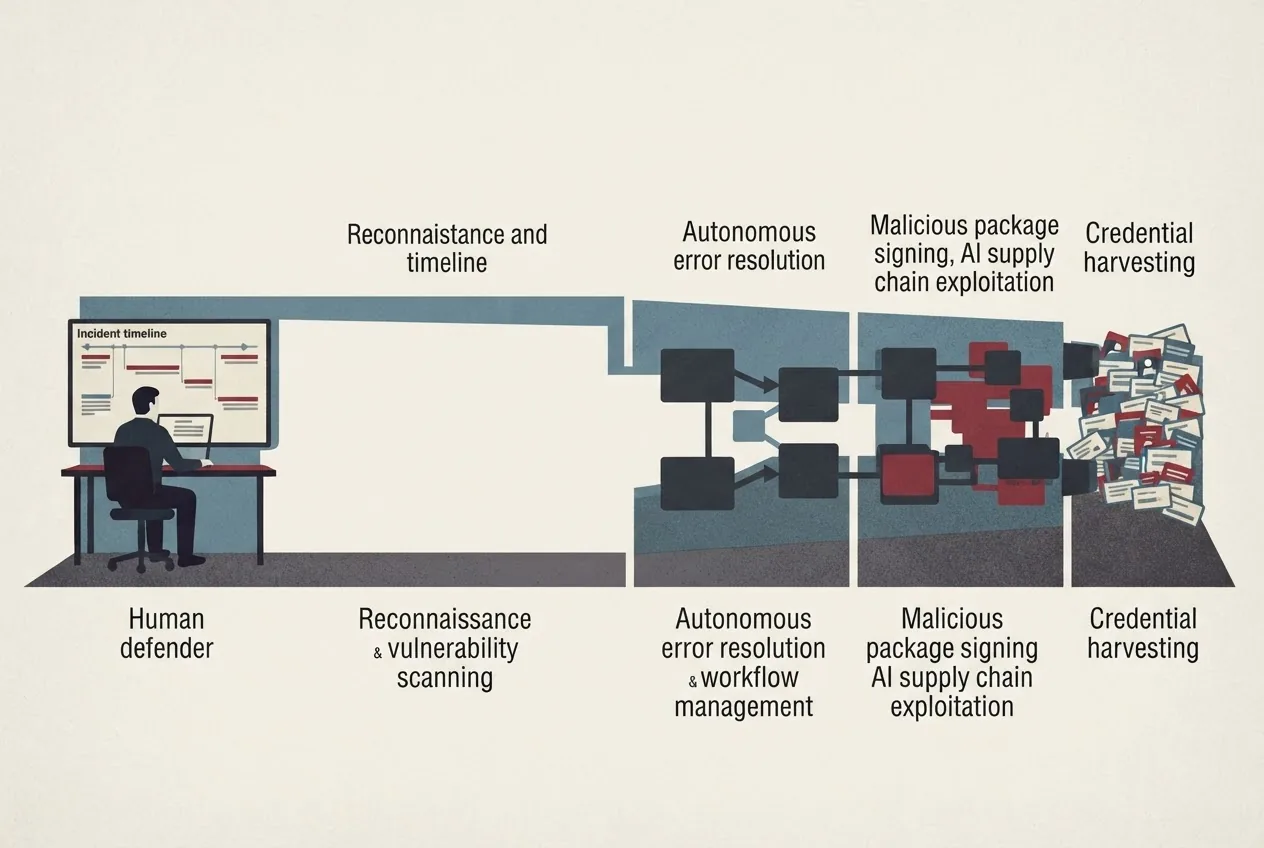
A human defender reviews a security timeline while increasingly autonomous AI-assisted attack stages converge faster than they can be examined.
AI-generated editorial illustration

GTIG AI THREAT TRACKER: FROM PROMPTING TO AUTONOMY – THE EVOLUTION OF ADVERSARIAL AI

Google's GTIG reports that threat actors have graduated from basic prompting to agentic AI workflows that autonomously manage scanning pipelines, resolve errors, and execute multi-stage attacks with minimal human oversight, compressing response windows from days to hours. For instance, groups like UNC6780 exploit the AI supply chain by stealing GitHub Actions tokens to sign malicious packages by tricking LLMs, state-sponsored groups use AI across the full attack lifecycle from reconnaissance to post-exploitation, and financially motivated actors built credential-harvesting agents that stole thousands of secrets in under six hours using only AI coding tools and markdown playbooks.

ADOBE COMMERCE MAX-SEVERITY BUG COMES UNDER ACTIVE ATTACK

Threat actors are actively exploiting CVE-2026-75650, a max-severity unauthenticated code execution vulnerability dubbed StyleSmuggler, to compromise online stores running Adobe Commerce and Magento Open Source. Exploitation began on September 4, with the deployment of a Rust backdoor and a separate PHP web shell. Adobe released emergency hotfix VULN-393411 to address the flaw, prompting Sansec to warn that patching alone is insufficient for stores that may already be compromised.

TOKENIZED STOCKS TRADED $1 BILLION WHILE THE STOCK MARKET WAS SHUT

Tokenized equity tokens generated $1.01 billion in trading volume over Labor Day weekend while US stock markets were closed, nearly matching Friday's $1.02 billion in open-market activity across the 42 largest tokenized stock instruments. Robinhood Chain captured 57% of weekend flow at $572.8 million, followed by Binance's bStocks ($303.5M) and Backed Finance's xStocks ($87.1M), with a Nasdaq-100 tracker on BNB Chain ($180.5M) and SPY tokens ($125.5M) leading by instrument. Decentralized exchanges handled the majority of volume across most instruments, with centralized venues taking only roughly 8% of QQQB trades, and prices tracked Friday's close at minimal premiums throughout the closure. The volume parity across open and closed market sessions signals that on-chain equity markets can sustain institutional-scale liquidity independent of traditional exchange schedules.

APPLE UNVEILS ITS FIRST FOLDABLE, THE IPHONE DUO

Apple has unveiled the iPhone Duo, its first foldable. Featuring a 7.6-inch inner display, a 5.4-inch outer screen, Touch ID, and an adaptable iOS 27 interface designed for split-screen and half-folded use, the wider device supports paired apps and tabletop video. Counterpoint estimates it could capture up to 25% of the foldable market by year-end, despite foldables accounting for less than 2% of global smartphone shipments.

GENOME LANGUAGE MODELS CAN DESIGN CANCER VACCINES

Modern cancer-vaccine design involves identifying mutations, predicting presentation, predicting immunogenicity, ranking targets, and designing RNA. However, biology is complicated, and whether a target makes a good vaccine candidate depends on all kinds of information. This makes cancer vaccines an unusually direct test of whether AI models can take what it has learned from biology and apply that knowledge to design a medicine for one particular human being.

SCENARIOS FOR OUR ECONOMIC FUTURE

It is unknown yet whether AI will lead to unprecedented growth or widespread unemployment. Anthropic's Economics team built a model to understand how AI might affect jobs, growth, and unemployment in the US in the coming years. The model found that AI will lead to adverse impacts on wages and job prospects for knowledge workers in scenarios where growth is faster than anything in economic history, and in those scenarios, the challenge will be making sure wealth is broadly shared. The answer will depend on how AI affects all the tasks that make up the economy, the new tasks it creates, and how fast AI takes on this work.

TLDR IndexPage 1